Saturday, 15 September 2012

Ondo Poll: We’ll Beat Mimiko Silly -Tinubu •You’ll Meet Your Waterloo In October -Mimiko

THE National Leader of the Action Congress of Nigeria (ACN), Senator Bola Tinubu, has expressed the confidence of his party winning the October 20 governorship election in Ondo State.
Tinubu spoke on Friday in Lagos upon his arrival from the United States of America.
He said: “We are  working hard for the October gubernatorial election in Ondo State. Our candidate is working hard. The party is working very hard. All our structures are in place. And as long as the election is well monitored and controlled, we are vey sure of victory.”
But the Ondo State governor and the candidate of the Labour Party in the state, Dr. Olusegun Mimiko, has described the former Lagos State governor’s submission as a pipe dream.
Speaking through his Commissioner for Information, Mr. Kayode Akinmade, Mimiko said: “Ondo people are not slaves. They will not worship on foreign altar. He will meet his waterloo in Ondo come October 20.”
Meanwhile, Senator Tinubu insisted that he was properly invited to the National Democratic Convention in America, describing the comments his attendance of the event has generated in the political circle as unwarranted.
The ACN leader, who arrived aboard a private jet, explained that the ruling party did not have the moral right to query his invitation to the convention which, he said, was not enough excuse for the party’s failure to address issues bordering on governance, privatisation process of the Power Holding Company of Nigeria and inability to put food on the table of the average Nigerian.
He described as noble, the opportunity he had to discuss with great minds at the convention, ideas that are central to the development and sustenance of democratic institutions.
He said further that his attendance of the convention had drawn unnecessary attention from the ruling party which, he said, had lost touch with the essence of people-oriented governance.
“It is unfortunate that we have not been able to distinguish between public contact and a proper democratic convention. There is a great exhibition of Nigerian ignorance and those scavenging  power in it’s corridors. They do not even appreciate  that fact that we fought for democracy. During the struggle for this democracy, there was a lot of precedence and people outside this country are still watching us. I  was at the convention. I was invited properly. Who are the people asking me to prove anything?
“Is it about the high rate of unemployment in this country? Is it about the inability of the ruling party to provide food on the table for hungry Nigerians? Is it about the state of electricity in the country that they cannot privatise properly, without blackmailing the former minister of power, who the government forced to resign, because that have the agenda of turning everything into a family affair?” he stated.

Ladoja’s accord with ACN redefining Oyo politics

Abiola Ajimobi and Rasheed Ladoja

That Oyo State is the nexus of South-West politics has continued to be evident in the current dispensation. Currently, a novel political drama is unfolding between the ruling Action Congress of Nigeria and the Accord Party, led by former governor of the state, Rashidi Ladoja.
At issue is the truce between the ACN and Ladoja’s Accord, shortly after the April 2011 governorship election, where the ACN candidate, Abiola Ajimobi, emerged winner.
And barely one month after he was sworn-in as governor of the state, Ajimobi’s party resolved to woo the Accord into an alliance: a move, which political analysts say was meant to help the ACN administration have a firm grip on the state.
By the calculations, the ACN needed the alliance with the Accord to have a comfortable majority in the state House of Assembly.
Going by the initial near tie between the ACN and the Peoples Democratic Party in the state assembly, Ajimobi’s party was not at ease.
After the election, out of the 32 lawmakers in the House of Assembly, 13 were ACN members, 12 were PDP members, while seven were members of the Accord.
However, with the defection of one Accord lawmaker and three PDP lawmakers to the ruling party, the number of lawmakers, who belong to the ACN rose to 17, while the PDP and the Accord were left with nine and six lawmakers respectively.
ACN had feared that the PDP – the leading opposition in the state – would constitute a threat to the Ajimobi’s administration. It was believed that in such circumstance, the governor would have found it difficult to push bills for new policies through the state assembly and that the PDP lawmakers could easily rally support and impeach Ajimobi in a bid to frustrate the ACN.
Therefore, in a ploy to forestall such occurrence ACN wooed the Accord through an agreement it allegedly reached with Ladoja.
Although some Accord loyalists in the state have criticised the move, it was difficult for them to go against the will of their leader and benefactor. And so far, the truce appears to be the strength on which the Ajimobi-led government has based its stability as far as the House of Assembly is concerned.
However, the agreement appears to have suffered a terrible setback. This is in view of the acrimony that greeted the appointments of some members of opposition political parties into Ajimobi’s government.
Some political watchers described the truce as one that almost got Accord loyalists and their party leader frustrated. Although Ajimobi was said to be willing to keep to the terms of the gentleman agreement by appointing certain members of the Accord, the step almost boomerang.
The move was vehemently criticised by some aggrieved members of the ACN, who believed the governor had traded their right to secure what they termed ‘unnecessary support’ from their enemy’s camp. Attempts to convince party members were met with protests and threats.
On several occasions, aggrieved party members had taken to the streets in protest of the decision to appoint Accord members into the cabinet or boards of state agencies.
Most resisted were attempts to appoint members of the opposition party as caretaker committee chairmen in some local government areas in the state. The latest was the concession of the chairmanship positions of Egbeda and Ona Ara local government councils to Ladoja’s party.
Although the development appeared to have yielded positive result as some members of the Accord and PDP in Ona Ara dramatically defected to the ACN, the governor’s action drew criticisms from some members of his party.
Interestingly however, the refusal of party loyalists to support the agreement between both parties was already drawing leaders of both parties into a cold war. Of course, Ladoja and some members of his caucus would not take that for an excuse.
And obviously in a bid to placate the former governor and his close aides, Ajimobi swore in Akinwale Akintoye and Akanni Ademola as new caretaker committee chairmen for Egbeda and Ona Ara. During their inauguration, Ajimobi told the Accord members to ensure that they run their respective councils in line with the principle and policies of the ruling party.
Ajimobi said, “You are expected as part and parcel of this administration and based on our arrangement with Accord Party; that you work according to the dictates, principles and policies of the Action Congress of Nigeria.
“Remember, it is an ACN government and therefore, as you are coming on board, you should know that you are wearing the cap of that government. When you finish and you go back to your Accord Party, then you are Accord Party but as long as you are with this government, you are of the ACN.
“Let me also say that where there is rancour, there will be no development. The politics we are playing now is politics of development and not of rancour or abuses. We, therefore, expect you to join hands with us so that we can achieve the aims and objectives of this government in line with the ACN philosophy.”
But hardly had the governor inaugurated the council chiefs than members of his party took to the streets. The protest rally went to Government House, the state House of Assembly and the Governor’s Office, all in Agodi, Ibadan. But their demand on Ajimobi to rescind his decision was turned down.
A member of the ACN in Ona Ara, Mr. A.O Adesina, however, condemned the governor’s insistence to honour his word by retaining the Accord party appointees.
He said, “We want to say that the appointment of an Accord Party member as chairman of our local government will be to the detriment of our party at a time when majority of the Accord and the PDP members are joining our party in Ona Ara local government.”
While the move by Ajimobi appears to be generating strife among members of his party, Ladoja appears resolute not to join any of ACN or PDP.
While addressing journalists in his Bodija, Ibadan residence, he indicated that he had resolved not to defect to any party. He disclosed that the negotiation on his return to his former party had been stalled.
He also added that he had resolved that his party would play the role of alternative party to the ACN and the PDP in the state.
He said, “My negotiation with the PDP is no longer on course. Accord Party will be an alternative party to the ACN and PDP in 2015. I cannot say emphatically that I would contest in 2015 because I don’t know if I will be alive then. I am not happy that local government council election has not been conducted in the state.”
He, however, hinted that the working relationship between his party and the state government was still on course affirming that Ajimobi invited his party to help him stabilise his government.
As it were, Ladoja’s efforts at fortifying his party ahead of the 2015 poll recently got a boost with hundreds of members of the All Nigeria Peoples Party in the state defecting to his party.
The defectors, who were from Lagelu Local Government Area of the state, led by Mr. Bukola Agboola, described the Accord as a natural habitat for him and his followers. Agboola stated that their defection had further reinforced the relevance of Accord in the council area.
Ladoja, while receiving them assured both the new and old members of his party of equal opportunities. His political scheming and strength has been described as unequal among the committee of political parties in the state. This, perhaps, is because of the noticeable increase in membership of his party. But the ruling ACN and the PDP are equally boasting of hope of election victory in the future.

My parents should be proud of me — Moses

Victor Moses
To Victor Moses, the images have a dream-like quality. The Nigeria winger had prayed since the beginning of July for the completion of his transfer from Wigan Athletic to Chelsea and there had come a point when he feared that it would not happen.
But, in a whirlwind week at the end of August he signed for £9m, was introduced to the Stamford Bridge crowd before the Newcastle United game, felt his eyes widen and his stomach flip during his first training session and then, the finale, watched the European Super Cup against Atlético Madrid as an unused substitute.
Moses speaks in shy, hushed tones but they do not disguise the awe and excitement that he feels. His arrival at Chelsea marks a significant staging post in his quest to reach the game’s summit, even if it pales in comparison to his broader journey from the depths of personal tragedy. His parents were murdered in Nigeria and Moses fled to England as an 11-year-old asylum seeker. He feels that they look down on him with pride.
Moses’s focus is on the future and the opportunities that he intends to grasp. He hopes to make his debut at some stage of the grudge fixture at Queens Park Rangers on Saturday, although to give it such billing feels crass in the light of what he has lived through.
The 21-year-old bristles with quiet determination. He was Chelsea’s final attack-minded signing of the summer, following Eden Hazard, Marko Marin and Oscar, who joined at a total cost of £60m, and with Juan Mata and Ramires also vying for prominence in Roberto Di Matteo’s line of three behind the main striker, the competition for places is ferocious.
“I don’t really know if it was Di Matteo or if it was the chairman or whoever but I knew that Chelsea were interested in me and that was it, really,” Moses says. “For a club to come and get you, they are going to use you at some stage. I know that there are a lot of players at Chelsea but if I do get my chance, I just have to grab it.”
Moses already has Chelsea stories to tell. He smiles when he recalls standing on a chair in Monaco, in the build-up to the Super Cup final, and being ordered to sing and dance for the amusement of his teammates. The initiation routine for new recruits has become a feature at many clubs. “I was nervous,” Moses says. “I thought: ‘What am I going to sing?’ because when I stood there, I literally didn’t know what to sing.”
For the record and the grime fans out there, Moses “kind of sang a Skepta song”. “It’s a little bit embarrassing,” he says, “… everyone watching me, thinking: ‘What is he singing?’ But it was all right.”
Moses has needed more than the occasional superlative of late. “The first training session was unbelievable … seeing JT, Ashley Cole, Torres and people like that, it was incredible, kind of crazy,” he says. “And the Super Cup, when I was watching it, I was thinking to myself: ‘I can’t actually believe that I’m here.’ I didn’t get on but I still got a [runners-up] medal.”
Moses’s appetite for precious metal, though, has been fired by a different encounter. “I saw the Champions League trophy the other day, it was at the training ground,” he says. “Everyone was having their picture taken with it but not me. It was the players that played in the Champions League. I just walked away, although I did touch it. I thought to myself: ‘Hopefully, we will win it again this year.’”
Moses’s single-mindedness and strength of character is evident and it is easy to connect it with the manner in which he has coped with his childhood trauma. His father, Austin, was a Christian pastor in Kaduna, and his mother, Josephine, helped with his work.
Violence, though, was depressingly familiar between the Muslim majority and the Christian minority and when riots erupted in 2002, Moses’s parents, who were obvious but unflinching targets, were attacked in their home and killed. Moses was given the news as he played football in the street. He became a target, too, and, after being hidden by friends for a week, he was sent to England, where he was placed with foster parents in south London. Upon his arrival in the country, he knew nobody.
“It has been a long journey from Nigeria and I just want to keep strong and work hard for myself, whether it’s football or not football,” Moses says. “I have to thank God for being where I am, it’s like a dream come true and, if I keep working hard, who knows, I’ll probably end up in Barcelona one day,” he says.
He made his Palace debut at 16 and was called up by England at every youth level. He won the Golden Boot at the European Under-17 Championship in 2007, in which England lost to Spain in the final, but his momentum was checked at Under-21 level. Stuart Pearce fielded him only once, against Uzbekistan in 2010, and the manager substituted him at half-time. Moses was not called up for the next game. “I played for England Under-16s, 17s, 18s, 19s, 20s and then 21s … then … I just decided to make the decision to play for Nigeria,” he says.
•Culled from guardian.co.uk

My style is universal — Banke Oniru

Banke Oniru
Background
I was born on August 11, 1979.  I am the fifth in a family of eight—four girls, four boys. I hold a diploma in industrial design from Yaba College of Technology and a degree in Business Administration from the University Lagos.  I also have a certificate in artistry from the London College of fashion.
My passion for fashion
I have known right from my youth that I was going into fashion. I can sew; I do my designs and the beadings. My fashion house, Semiloge couture was launched as a result of this passion. I am concentrating on exclusive clientele but its gradually opening up to others in the general public. Ankara? Well, I don’t really use Ankara. I have discovered that most designers in Nigeria use Ankara, which is why I decided to go for water chiffon and raw silk. Our weather is not friendly, it is hot. Chiffon is weather- friendly and sexy. My style is basically universal. I love comfort and convenience.
Fashion business in Nigeria
It is going places and we are going to take over the world in five years’ time. The Nigerian fashion scene is influencing global trends from Milan to Italy and New York. Nigeria designers expensive? Never! The designs are unique. Did you know that most of the original designer bags in Nigeria are as expensive as N350, 000? A simple designer tank top can sell for as much as $300.  Then, compare that to what we charge here.
Marriage
I am married to Demola Oniru. I met him at a wedding and he said I looked like someone he knew. Then, we became acquaintances and he kept telling me that he had made up his mind to marry me. I was reluctant at first but he persisted and that convinced me that he was serious. If you want to be successful in life, your husband has to be in support of your idea or it would never work. What I am doing is not taking my time. I am always there for my family.  There was a time I ran a boutique but I stopped because I don’t want to be stressed.
Favourite fashion accessory
I don’t have a specific one but I love most fashion accessories like bags, shoes and jewellery.
Beauty routine
I love doing my make-up and I use a primer before applying the eye shadow. I also base before I fix them with concealer, after which I apply foundation. My hair? I don’t wear Brazilian hair. I prefer the Peruvian hair. It is a wise option because while you buy all these cheap ones and throw them away after use, you can use your human hair forever if you know how to maintain it. I have been wearing this for the past one year. Once you condition it, you are good to go. It is human hair so you have to treat it the way you treat your hair.
Leisure
I am a very restless person. I don’t watch television but I listen to music since I am an artist. Music keeps me relaxed especially while I am sketching. I also love to be by the poolside on Sunday evenings.
Banke Oniru runs a clothing line, Semiloge Couture.

Winning a case against FRA Williams, not my greatest, but … — Wale Osomo

Wale Osomo
Wale Osomo is a man of many parts. He is a lawyer, a school proprietor, a sportsman, he is into real estate, a politician and a socialite.
Osomo, the proprietor of Estaport Group of Schools, says, “I noticed the appalling situation in the educational system in Nigeria and the idea of a school came up at a time when it was the fad for people to buy certificates for their children who showed little interest in education. I felt that if I went to school and passed my exams myself without my parents buying my certificates, then I do not          see any reason why any other child shouldn’t be able to do same.
“I saw a gaping hole and decided to do something even if it is within my own enclave. It has cost me a lot of time, effort and resources but today, the teachers, students and the larger society are better for it. I raised funds from my legal profession and pumped it into the school. That is my own way of giving back to the society and it has been worthwhile.
“In the last WAEC result, while the national average score was 30 per cent, our average score was 80 percent in both Mathematics and English language. In my own estimation, 80 per cent isn’t good enough because I had a pact with these children’s parents to train them to deliver in excellence.”
His first degree was in banking and finance but he decided to study law for two reasons: he felt he was too young to get a job at 21. Then, there was pressure from his mother, Mobolaji Osomo, a property lawyer (was also a former minister of housing during the Olusegun Obasanjo administration).
But by the time he floated a mortgage bank, he knew his initial degree was not in vain. A former legal adviser to the Mortgage Bank Association of Nigeria, the Ilaje, Ondo State indigene explains why he opted out.
“The money involved in running a mortgage institution is too humongous for a businessman. Even mortgage institutions run by public entities are still grappling. So, I decided to face my real estate business which has always been the main forte of the family business.”
Having come from a politically inclined family, Osomo who has plans to vie for office either at the state or national level has already begun learning the ropes with his election as the president of the Lagos Country Club, Ikeja.
He explains. “My campaign team and I had a vision. We were fed up with the way things were being done and felt we should have a transformation. We promised policies, project and programmes in terms of infrastructure, services and the image of the club. We have been able to deliver on a number of these promises. Now, a lot of high profile multinationals have shown interest in doing business with us. They want to partner with us in our development strides.”
On challenges of the office, he says, “First, it was losing a close friend of mine just after assuming office. Again, it was difficult trying to get people, especially members of the first generation of the club, to buy into my vision and make them adapt to the change. For the first six months, everyone was watching to see what I would do. I was told that it isn’t so much of being able to sound like Barack Obama in oratory, but being able to transform all of the speeches I made into reality.”
Born over 47 years ago, the blue blood recalls with fondness his growing up years:
“My father retired as a manager of the old National Bank. A goal – getter who was very vibrant, I was however, a bit distant from him. I didn’t really know much about him because he was hardly ever at home. When he retired, he set up the family business and then went into poultry farming which further took him away from us. But my mother was always in our face; she was a strict woman and we all grew up very disciplined. Rules were set and we dared not fall short of expectations or else, we were made to face the consequences.”
A fitness freak, Osomo not only plays lawn tennis and swims regularly, he used to be the number one snooker player in Nigeria having represented the country at various times, garnering up to 50 trophies both in lawn tennis and snooker. Equally passionate about sports, the dismal performance of Nigeria at the just concluded London 2012 Olympics has further spurred him to do something enduring in the area of sports.
“Nigeria obviously has nothing to offer in terms of sports,” he laments. “As a sportsman, I have decided to give myself the challenge to handpick and train some children ready for the Olympics, maybe two or three Olympics from now. I know it can be done if I set my mind to it and talk with a few others who would be willing to pool resources with me. It is something I aspire to and hope that it would come to pass as that would be a great achievement for me.”
In the interim, he considers his greatest achievement as the day someone walked up to him to thank him. For what?
“He was a former student of my school and he made a second class upper in economics from the University of Lagos. The fact that I took someone else’s child and trained him to the extent that he could come back to say thank you is humbling. Not even a case that I won against the late Chief Rotimi Williams could take the cake.”
For this singular reason, he plans to set up a university. But not with the intention to turn it into a cash cow.
“I am not planning to set it up and make it a cash cow,” he explains. One must have a good reason to set up a university and that is, contributing to the development of the society. So, yes in due course, I will, but not very soon.”
Don’t tag him as a stylish person. He confesses that his law profession prevents him from experimenting. “As a rule, I do not wear agbada except I am forced to. I can count the number of kaftan outfits that I have on my fingers. I am most comfortable in my jackets, shirts and trousers,” he enthuses.
While he isn’t a fashionable person, he is very careful about his diet. He says, “I am very finicky about what I eat but you would melt my heart when it comes to chicken and chips.”

Wednesday, 12 September 2012

‘No going back on Igbo presidency’

Okonkwo Okonkwo
 
The President of Committee 21 (C21), Southeast’s non-political organisation, which was established to push the Igbo agenda, Senator Annie Okonkwo, has said the Igbo would settle for nothing less than the presidency in 2015. 
The Senator who spoke with The Nation in Lagos  noted that the purported moves by some prominent Igbo politicians to adopt  President Goodluck Jonathan for the 2015 poll was against the overall interest of the Igbo people.    
He said: “The All Progressives Grand Alliance (APGA) has already made it clear that it will present a candidate for the 2015 election. The chairman of the party, Chief Victor Umeh, expressed this in strong terms. If the Peoples Democratic Party (PDP) decides to adopt Jonathan, let it be; that is a party affair, but as for the people of the Southeast, we are determined to push for Igbo presidency.”
The Senator said that despite  moves by some divisive element in the actualisation of the Igbo agenda, it will come up stronger because the people are behind the dream. “The C21, market women, Okada riders, elders, all religious groups and every Igbo man are involved in this struggle and they are all connected to C21. And the membership of C21 cuts across political lines and our objectives are very clear.”  
Reacting to Governor Peter Obi’s alleged support for Dr. Jonathan, Okonkwo said Obi was merely playing his role as governor and did not express the stance of the Southeast: “With due respect, he is a governor and he, as an individual, has his own views. The way it is today, everything is decided by the party; he is not in control of the party, he is not in the party machinery and of course he is not in control of any organisation that he will speak for the Igbo. He is just there in that capacity as the governor. And of course, if he decides to go and support Jonathan, that his is own wish.” 
Explaining further, he said as governor of a state with his function and responsibilities, he was playing his role. “That he is the governor does not mean that he will forge the path for the Igbo people. He is not the chairman of a political party which should put him in the position of speaking for the party. The chairman of APGA has made it very clear that the Igbo would field a candidate for the 2015 election. APGA has been adopted as a political party for all the Igbo.”
The former senator who was until recently a member of PDP maintained that APGA was capable of coming up with credible candidates who can conveniently run the affairs of the country in presidential capacity. “We have credible candidates and people with high integrity who are interested in occupying the number-one position. And as far as we are concerned in respect of the presidency, the Igbo people are still consulting in respect of the kind of candidate we are going to present. The candidate we will present will be acceptable by Nigerians,” he said. 
Though APGA has its stronghold in the east, this, according to the senator, is not a major threat; rather, it would throw up new friendship through alliances with those who share Igbo agenda. He said: “As far as I am concerned there are going to be some alliances, and of course the Igbo are everywhere. They are spread all over the country; it is the only tribe that is fully spread everywhere. They are well numbered in Kano, Kaduna and other parts of the country. But still, I believe there are going to be alliances with people who share the same vision with us.” 
Given previous alliances which have always offered the Southeast the position of Vice President or other lesser position, the senator stressed that it was not going to be business as usual because 2015 is a project that all the kith and kin of Igbo stock are committed to. 
Okonkwo said further: “As far as I am concerned today, the Igbo have made it clearl they will not play second fiddle. The truth of the matter is that today, we are nowhere; we are not even the second or third. The truth of the matter is that whatever anybody is telling you, we want to make our position very clearly to demonstrate that we have the capacity and we are united for this purpose.” 
Drawing from the spread advantage of the Igbo who are  resident in every community in Nigeria, he said that would give it a lead to make the Presidency aspiration realistic. “Despite this advantage, the position we have found ourselves is not right, but we are going to correct this.” 
President Jonathan who recently commissioned some projects in the Southeast and promised to complete the Second Niger Bridge was applauded for paying attention to the infrastructural development of the zone. 
Though it was said this would ensure support for the president’s bid, according to the senator, this will not make them change their position: “That is democracy; do for the east what is due for them. The east has been neglected for quite long. Even if the president goes beyond what government is supposed to do, that does not change our mind. We are set to achieve what we want to achieve, even if he puts all the gold and how are we sure this will not go like one of those promises others had made in the past?
“Many presidents have come to make promises. They had come with promises of sea port and other projects, but the moment they realise their ambition, the Igbo are neglected. This time around, we are not going to fall for those white elephant projects and empty promises. I do remember the talk about sea port which has been on right from the Shehu Shagari regime. The roads are in terrible condition, so we want to see a practical development.”

Juwon Oshaniwa joins MS Ashdod

Super Eagles first choice left back Juwon Oshaniwa has spent his last days in the local league.
After passing a routine medical examination, the former Sharks defender has signed a four -year contract with Israeli top flight club MS Ashdod, until recently the club of another Nigeria international Efe Ambrose.
Dudu Dahan, it won't be out of place to call him a super - agent in Israel, was involved in negotiations that took 21-year-old Oshaniwa to MS Ashdod.
The Israeli club have so much faith in Dudu Dahan and Juwon Oshaniwa. They have bypassed their scouting policy to sign the highly rated Nigerian wing-back without the mandatory tests.
It remains unclear if Oshaniwa would be eligible to make his league debut for The Dolphins in Thursday's league game with Beitar Jerusalem. Ashdod have not received the player's International Transfer Certificate from the Nigeria Federation.

OCTOBER 13 SHOWDOWN: Ayew backs Lone Star to crush Eagles

Ghana  star Andre Ayew is backing Liberia to qualify to next year’s African Cup of Nations.
The Lone Star played out their skin to force a 2-2 draw against the Super Eagles in the first leg of the qualifier to the 2013 African Cup of Nations at the Samuel Kanyon Doe Stadium over the weekend.
After coach Kaetu Smith’s charges managed a shock 2-0 win over the Black Stars in a friendly on Tuesday, the Marseille winger is confident they can scale the hurdle against the Nigerians in their return encounter.
“I love their spirit and mentality and I believe they can go to Nigeria and cause an upset,” Ayew told reporters.
“I am supporting them to qualify to the Nations Cup because it been a long time since they’ve been there.
“They have a strong team which can surprise any side on a good day.”
The return leg will be played next month in Calabar with the overall winners advancing to the Nations in South Africa next year.
Liberia has qualified for the Africa Cup of Nations only twice and last played at the continental showpiece in 2002.

NFF to Keshi: Talk less!

Keshi  
Keshi
 
• Insists on focused Eagles ahead of Liberia tie • Camping to start early

The Nigeria Football Federation (NFF) has told the Head Coach of the Super Eagles, Stephen Okechukwu Keshi, to concentrate on his effort at building a formidable team for the country and should not be seen engaging in media warfare in his bid to defend his actions.
The Federation says Keshi should speak less and think more of what to improve upon in his rebuilding process of the senior national team instead of dwelling on non-essentials.
So many controversies have trailed Eagles' 2-2 draw in Monrovia and has been termed unacceptable among the team's faithful but the Chairman, Technical Sub Committee of the NFF opined that Keshi's main priority should be on the return leg slated for October 14 in Calabar and not the first leg that had been added to history books.
"Already I am not happy that Keshi is talking. I want us to get focused and let us not be talking and get the job done for the entire Nigerians. it is not for an individual. Keshi is the chief coach of the Nigeria's Super Eagles and not that of his own team. We need to set our priorities right ahead of the return leg.
"The Liberians are reading whatever we say and they know what is happening. We went through hell in Liberia and start another round of crisis in Nigeria here does not augur well for our preparation for the second leg," Barrister Green disclosed to SportingLife.
He also confirmed that the Super Eagles would open the camp with those based in the country first before the end of the month and not October 4th already mentioned in the media.
"The Eagles will begin camping for the return leg match against Liberia before the end of this month. You know that this present board of the NFF always gives various national teams a long period of time to get prepared for any competition and the Eagles' case will not be different,” he added.

Fayemi Presents Ekiti Laws To CJN

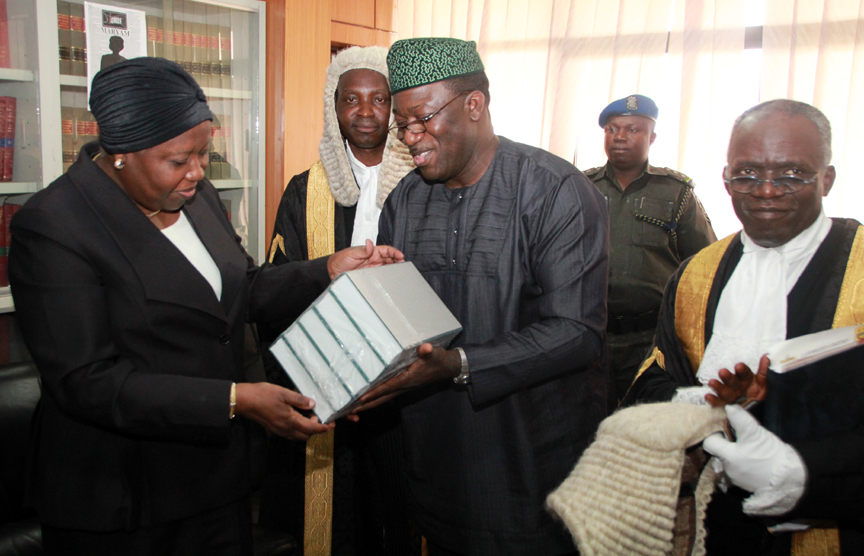
Ekiti State Governor, Dr Kayode Fayemi (2nd right); presenting the New Laws of the State to the Chief Justice of the Federation, Justice Mariam Aloma Mukhtar ; in her office, shortly after the Inauguration of the award of New Senior Advocates of Nigeria (SAN), with them are Attorney General and Commissioner for Justice, Ekiti State, Mr. Dayo Akinlaja (SAN); and foremost Human Rights lawyer, Mr. Femi Falana, at the Supreme Court, Abuja... on Wednesday.

Ekiti State Governor, Dr. Kayode Fayemi on Wednesday presented the first edition of the Laws of Ekiti State to the Chief Justice of Nigeria (CJN) Hon. Justice Aloma Mukhtar, in Abuja..
Presenting copies of the laws to Justice Mukhtar at her office at the Supreme Court Complex,  Abuja, Governor Fayemi said the gesture was to keep the Supreme Court abreast of the new laws, a gesture that has finally freed the state from its 15 year-long appendage to its sister state, Ondo State.
Fayemi said the publication of the laws of the state was an important milestone in achieving certainty and predictability in the administration of justice in the state as the gesture would ease the stress of legal practitioners, students of law, academia and stakeholders in the justice sector who had to “sieve through the laws of old  Ondo State to find the true position” of Ekiti laws.
He reiterated the commitment of his administration in Ekiti State to a system of justice that is simpler, more efficient, more effective and more responsive to the needs of Ekiti people; saying that the vision of the administration is to bring about a justice system that guarantees fair and equal access to justice.
While presenting Mr Femi Falana and Dayo Akinlaja who have just been inaugurated as Senior Advocates of Nigeria (SAN), Fayemi however informed the CJN of the on-going effort in the Administration of Justice Reform.
In her remarks, the Chief Justice of Nigeria, Justice Mukhtar commended the effort of the State Government under Governor Fayemi for embarking on the new laws, saying that the gesture will make the dispensation of justice easier, especially in quoting from the laws.
Mukhtar who expressed joy that the new laws have come during her tenure as CJN, asserted that it is ideal for the State to have its own laws after 15 years of creation.
It would be recalled that Governor Fayemi appended his assent to a bill on the first edition of the laws of the state on the 9th of March this year.

Breaking News: Samsung to establish Engineering Academy in Ado-Ekiti

From: Ekiti Panupo Yahoo Group       Published on: Tuesday, September 11, 2012
Electronics Giants, Samsung is set to establishing an Engineering Academy in Ado Ekiti, the state capital as part of its partnership arrangement with the state government.

This is part of the Memorandum of Understanding (MOU) signed by the state government and the management of Samsung in Seoul, South Korea on Monday.


Ekiti State Governor, Dr Kayode Fayemi signed for the state government, while Mr. Seongwoo Nam, Executive Vice President (IT Solutions Business), signed on behalf of Samsung at a brief ceremony at the company’s head office in Seoul.


According to a statement by the Chief Press Secretary to the Governor, Mr Olayinka Oyebode, other areas of collaboration between Ekiti State and Samsung as agreed in the MOU, include e-governance, healthcare, technology park, smart city and safe city initiatives of the Ekiti State Government.


Governor Fayemi said the partnership with Samsung will boost the state government’s ICT plans, especially its e-school, e-payment and e-government projects.


It is recalled that Samsung is one of the major partners in the state government’s Computer-per – child


initiatives (e-School project) which is designed to put a laptop computer on the desk of every student in the state’s public secondary school by 2014. Already, 33,000 laptop computers of the planned 100,000 are being distributed across the state in the fist phase of the project.


Olayinka Oyebode


Chief Press Secretary

I fear no players' revolt - Keshi

alt
Keshi
SUPER Eagles head coach, Stephen Keshi, believes he still has the backing of his players in spite of the indictment of his team following a 2-2 draw with home side, the Lone Star of Liberia in a 2013 Nations Cup qualifier in Liberia last Saturday.
Keshi tore into his charges for failing to convert begging chances against Liberia and yesterday, said somebody must call the shot when the chips are down.
“We are all adults and when we need to joke, we joke,” he stated on Tuesday.
“What happened in Liberia must not repeat itself and that is what we discussed. As a coach, I have no personal issues with my players; we are like brothers and I believe they understand my feelings. We are in this together.''
When asked if he feared players'revolt following his post-match outburst, the former national team captain explained that the team is still intact and focussed.
“My idea is not different from that of the players. Off the pitch, we discussed the way forward and till today, nothing has changed. I believe my players are still loyal to me and the country.''
Keshi also dismissed the notion that the Eagles underrated the Lone Star.
“No! I alerted the players that the environment would be electrifying and that is what we saw.
“I asked my players to forget the fact that we once beat them but like I said, we should have won the game. We have to change our attitude if we are to fulfil our potential.''

Babangida’s burden of timeless questions

alt
Ibrahim Babangida
Former military president,General Ibrahim Babangida, spoke with journalists at his Minna, Niger State home when he turned 71 recently. Abiodun Awolaja looks at some of the issues not covered by the interview but which have come to define the general’s place in the polity over the years.
OF Nigeria’s former Heads of State/presidents, General Ibrahim Babangida arguably holds the record for the highest number of unsolved puzzles relating to alleged criminality, treachery and tyranny. In terms of crude brutality and state-sponsored murder, arson and brigandage, not a few would contend that the succeeding regime of General Sanni Abacha (1993-1998) easily dwarfs his administration (1985-1993). IBB, as his courtiers fondly call him, remains the major issue in the polity after General Olusegun Obasanjo, the only Nigerian alive who clearly dwarfs him, in terms of political power and influence. He has managed to build an aura of nobility around himself, helped largely by media coverage, although some of his actions as military president have since remained potent threats to the sovereignty of the same country which he fought gallantly to keep together during the civil war of 1967-70.
Thus, when he turned 71 recently and granted a fairly comprehensive media interview, many who have insisted that they still carry the anguish inflicted by his administration, including the families of former aides and friends assassinated during his regime, might have hoped that he would at least offer one word of comfort by saying that he regretted the cause of their anguish. That was not to be because the influential General studiously avoided speaking on the Gideon Orkah coup, the Mamman Vatsa killing and the June 12 1993 questions, which threaten to haunt his image perpetually.
Although Babangida has addressed these issues at various periods since he was disgraced out of power on October 1st, 1993, critics have not stopped asking questions about them, apparently because they are unsatisfied with his explanations. In a sense, therefore, the Minna-born general may consider this unfair because he has laboured to explain his role in the various issues and has always insisted that his actions were taken in the national interest.
Speaking with newsmen at his hill top, Minna, Niger State residence, Babangida , who spoke on the clamour for state police, the Boko Haram issue, among others, said he was not bothered by criticisms about his administration. Hear him: “Normally, I don’t consider it (criticism of his administration) as a problem. To be very honest with you, in the last 23 or 22 years since I left office, it is the same sing song either by the media or by the columnists and so on.If somebody looks at me and says yes, during his time he liked corruption, now the question is, in the name of God, aren’t you capable of doing something for the last 22 years or you just fold your arms and wait until somebody does the same thing?’’
The Minna general particularly made headlines because he backed the creation of state police despite claims by a former Inspector General of Police, Gambo Mohammed Jimeta, that he (Babangida) actually destroyed the police during his eight-year tenure. His position , directly opposed by President Goodluck Jonathan who claimed that the country was not ready for state police, was retrospective: “During the 1959 elections, the police or the Yan Dokas were used to beat up or harass the people who were opposed to the government of the day . People should try to move forward. It grieves me that because something happened in 1959, Nigerians still think it can happen in 2012. A lot of things like the constitutional amendments have been put in place and I am not sure a governor would use the state police to intimidate the people who are opposed to him because the people can go to court and seek redress .
But during an interview with journalists at his Maitama residence in Abuja while reacting to Babangida’s endorsement of state police, Jimeta virtually took the general and his colleagues to the cleaners, suggesting that he (Babangida) was merely playing politics with the issue. “While serving under him (Babangida), we had serious differences on the issue of law and order. When the military took over the system of budgeting for the police, the police was destroyed. Throughout the country, what you have as police establishments were provided by the First Republic leaders.’’ Apparently, Jimeta refused to believe that the general may have changed with time.
On another plane, the Vatsa story illustrates the absurd comedy of military intervention in Nigerian politics. A marabout was said to have prophesied during the civil war that each of Babangida, Abacha and Vatsa would become president of the country at some point. A conspiracy theory thus holds that Vatsa was the victim of personality/power politics, particularly given his intellectual disposition as a soldier-poet. Major-General Vatsa , Minister of the Federal Capital Abuja and a member of the Supreme Military Council, was executed on March 5, 1986 following accusations of his involvement in an abortive coup. Vatsa and his fellow victims were tried by a Special Military Tribunal set up by General Domkat Bali, the then Defence Minister, at the Brigade of Guards Headquarters, Lagos. The accused officers included Lt-Colonels Musa Bitiyong, Christian A. Oche, Micheal A Iyorshe and M. Effiong; Majors D.I Bamidele, D.E. West, J.O Onyeke and Tobias G Akwashiki; Captain G.I L Sese, Lieutenant K.G. Dakpa; Commodore A.A. Ogwiji, Wing Commanders B.E. Ekele and Adamu Sakaba; and Squadron Leaders Martin Luther, C. Ode and A Ahura.
Chaired by Major General Charles Ndiomu, the tribunal, comprising Brigadier Yerima Yohanna Kure, Commodore Murtala Nyako (now the governor of Adamawa State), Colonels Rufus Kupolati and E. Opaleye, Lt. Colonel D. Muhammed and Mamman Nassarawa, a commissioner of police, tried the officers under the Treason and Other Offences (Special Military Tribunal) Decree 1 of 1986. The charge against Vatsa was that a farming loan he gave to Lt-Colonel Bitiyong was actually for the purpose of planning a coup against the government. As stated by Nowa Omogui, a military analyst in his essay, ‘The Vatsa Conspiracy’, Musa Bitiyong, was allegedly tortured to implicate Vatsa by making reference to certain private political conversations they had, claims which Vatsa vigorously contested.
Decades after his death, Vatsa’s ghost still haunts the seat of power. His widow, Sufiya, wrote former President Olusegun Obasanjo a letter dated 15 June, 2006, canvassing the trial of Babangida for the ‘murder’ of her husband: “Although there was no iota of evidence linking my husband with the phantom coup, he was convicted and sentenced to death by the Special Military Tribunal which purportedly tried him and other coup suspects. My husband’s appeal to the Armed Forces Ruling Council against his illegal conviction was yet to be considered when the Head of State, General Babangida had him secretly executed along with the other coup convicts, she said. Evidence that Vatsa may have been set up was provided when, speaking in a 2006 interview, the man who announced Vatsa’s execution, Bali, said “My regret is that up till now, I am not sure whether Vatsa ought to have been killed because whatever evidence they amassed against him was weak. My only regret is that I could not say, don’t do it. I am not so sure whether we were right to have killed Vatsa.”
Babangida himself, speaking with THISDAY newspaper when he turned 60 in 2001, offered a rather lame logic for the conviction of the general. According to him, “Vatsa tried to escape through the airconditioner hole. I couldn’t understand why he was trying to escape if he was not involved in a coup plot. But while watching the video of his execution, I turned my eyes away when I saw him remove his watch and ask a soldier to give his wife. I couldn’t continue watching.” Babangida’s logic, impoverished in its failure to grasp the practical reality that even an innocent man would try to escape from the jaws of death if he thought he had a good chance of making it, grumbled that he could not retire or imprison Vatsa because he (Vatsa) could still have planned a coup either in retirement or in prison. “Rawlings did it in Ghana and you know Vatsa was very stubborn,” IBB said. Presumaby, even more so was Gideon Orkah, arrowhead of the aborted 1999 coup who equally met a grievous end despite organising the most bloody coup in the country’s history.
Nor did the IBB at 71 interview touch on the June 12, 1993 presidential election won by the late business mogul, Chief MKO Abiola, by all means his major albatross in the polity, a sure campaign tool against him or any of his family members, including his son Mohammed, who is reported to be nursing a gubernatorial ambition. Had the general not annulled the globally acclaimed 1993 election, he would easily have picked a presidential ticket like his former boss, Obasanjo, and returned to office in Babaringa years after leaving in a heavily starched khaki. For Babangida, then, the lesson of leadership may be captured in the Yoruba proverb that the pounded yam of 20 years’ standing may still scald one’s fingers. There is obviously many more battles ahead of the mercurial general.

OLA VINCENT: Exit of quintessential Banker

alt
Ola Vincent
It has been a ceaseless outpouring of tributes for the former CBN governor, Mr Ola Vincent, since he passed on to eternity precisely on Monday, September 3. In this report, Odidison Omankhanlen, chronicles the life and times of the quintessential banker and what people from all walks of life have been saying about him.
IT was the inimitable playwright and poet, Shakespeare, that wrote in one of his books, Julius Caesar, that when beggars die there are no comets seen, the heavens themselves blaze forth the death of princes. This captures the outpouring of eulogies from people from all walks of life including the number one citizen, Dr Goodluck Jonathan; Senate President, David Mark; state governors and of course, his primary constituency, the financial community, since he breathed his last.
What could be gleaned from comments by people in the condolence register and grave side funeral orations is that Vincent was a man of integrity who lived a fulfilled life. President Jonathan said Vincent’s death was a loss to the country. In a statement by his Special Adviser on Media and Publicity, Dr Reuben Abati, the president recalled his outstanding contributions to the economic development of the country during his long public service career.
“As they mourn him, however, we should give thanks to God Almighty for Mr Vincent’s very successful and fulfilled life of service to his family, community and the nation,” the statement said.
The president assured the family that his memory would remain indelible among Nigerians because of his selfless service to the nation.
On his part, the Senate President described the death of Vincent as a monumental loss to the nation. In a condolence message by his Chief Press Secretary (CPS), Mr. Paul Mumeh, Mark noted that Vincent was a quintessential economist, banker and industrialist with very high moral standing and integrity.
According to him, “Vincent, was a patriotic Nigerian, a philanthropist, a very diligent and meticulous banker who stood to be counted when it mattered. We shall miss his humility; we shall miss his sense of humour. We shall miss his knowledge, intelligence and wise counsel. We shall miss his kind gesture.”
Lagos State governor, Babatunde Fashola, said the late Vincent’s selfless service to the country would remain indelible, stating that he would be greatly missed by the financial community and Nigerians at large. “I have fond memories of Papa Vincent, his selfless service to the country and the leadership that his generation provided at very critical times. He truly served and we remain inspired by such virtuous patriotism”, he said. A former bank chief executive, Opeyemi Agbaje, stated that the apex bank under Ola Vincent was a revered institution, noting that he promoted the ideals of professionalism.
A former CBN governor, Dr Joseph Sanusi, described Ola Vincent as “A unique professional, a central banker to the core.” He noted that the former CBN governor “was a mentor, a role model and a true icon.”
Also the Chairman of First City Monument Bank (FCMB), Otunba Subomi Balogun, described the late Ola Vincent as the most outstanding CBN governor of the country.
“The nation has lost one of the finest professional bankers. He was the most outstanding CBN governor we have ever had, a thoroughbred professional, a professional with uncommon touch. An inspiration, who God used to make some of the country’s successful bankers. A man of God, humble to a fault and a fearless defender of the cause of justice. The symbol of all that is best in banking,” Balogun wrote in the condolence register.
Former Commonwealth Secretary-General, Chief Emeka Anyaoku, on his own part bade “goodbye to a truly outstanding governor of our CBN and a great human being. Ever so generous and humane in relating with people irrespective of their social standing.”
The President of the Chartered Institute of Bankers of Nigeria (CIBN), Mr Segun Aina, said the former CBN governor lived a “good life worthy of emulation, a great mentor, distinguished banker and a strong believer of his faith.”
Signing the condolence register, the Chairman of MTN Communications Nigeria, Mr Pascal Dozie, wrote: “one of the most understated and unassuming Nigerian professional. His type is rare in any country.”
To the former Director-General of the Nigerian Stock Exchange, Apostle Hayford Alile, the late Vincent was not only a success on the professional scene, but an all-round achiever in the social, private and career routes.
According to Alile, having done well as a husband, father, community and church leader, the numerous descriptions of Vincent’s life as one worthy of celebration on many fronts simply reaffirm the former CBN governor’s indelible prints in all facets of his life.
The Vice-Chairman, IGI Insurance Plc, Mr Remi Olowude, who recalled all the good times they had together, serving on the board of IGI until his death, described Vincent as an epitome of integrity, hard work, intellectualism and patriotism.
He said, “Baba is an epitome of the old national anthem that we abandoned, which said, ‘Though tongue and tribe may differ, in brotherhood we stand.’ That was Baba. He had no time for tribal issues; all he had time for in his life were real issues. He was a man of high integrity. Besides, he was a highly cerebral person, probably one of the best economists of our time.
“He was a moving encyclopaedia, especially on corporate governance. He was a founding shareholder and director of IGI insurance. He helped the board of the company to run what became the best company with the highest ethical standards in Nigeria. At over 80, he was still a member of the Board of Directors of IGI till his death. May his soul rest in peace.”
Ola Vincent as CBN governor
The late Ola Vincent was the Governor of the CBN from June 1977 to June 27, 1982, a time when the nation faced very dire economic challenges. His expertise in handling his role as the governor helped in providing stability and economic growth. Prior to his appointment as Governor, he was Deputy Governor from April 1, 1975 to June 28, 1977. Some key achievements of the late Vincent include the following: introduction of the N20 banknote with the portrait of former Head of State, Late General Murtala Ramat Mohammad, in 1977; introduction of the portraits of eminent Nigerians on the N10, N5 and N1 banknotes in 1979; opening of 10 CBN branches between 1978 and 1981 namely: Sokoto, Ilorin, Calabar, Bauchi, Abeokuta, Akure, Owerri, Makurdi, Yola and Minna. This brought the number of CBN branches to 18 in 1981.
He also embarked on the conceptualisation, launching and setting aside of funds for the Agricultural Credit Guarantee Scheme (ACGS) as well as the midwife of the computerisation of the bank's operations tagged "Central Bank of Nigeria Computerisation Project" in 1978. That was the computerisation of the pay roll process, customer and general ledger, foreign exchange control, public debt, economic modelling and forecasting, statistical computation and analysis. He also laid the foundation stone of the Staff Training School at the Satellite Town, Lagos.
According to the apex bank, “as we mourn the passing away of a great icon, we are comforted by his exemplary life. The CBN family will continue to remember him as a great, visionary and worthy leader.”
Born in Lagos on May 16, 1925, Vincent attended CMS Grammar School, Lagos, between 1936 and 1939. He also attended the Administrative Staff College of England in 1951. He was at the University of Manchester from 1953 to 1956 for his degree programme. He was Senior Assistant Secretary in the Nigerian Ministry of Finance (1959–1961) and then moved to the CBN as an Assistant General Manager, becoming a General Manager at the CBN from 1963 to 1966. He was a Director at the Nigerian Industrial Development Bank (1964–1966). He was appointed a Vice President at the African Development Bank, Abidjan, Côte d'Ivoire (1966–1973). He returned to the CBN in 1973 as an Adviser, becoming Deputy Governor in 1975 and Governor from 1977 to 1982. Vincent was named a Commander of the Federal Republic (CFR) in 1982.
Following his retirement from the CBN, in 1983 he recommended the establishment of the Nigeria Deposit Insurance Corporation (NDIC), which occurred in June 1988. The NDIC provides a safety net for depositors in the newly liberalised banking sector.
He was a life member of notable professional bodies, including the Nigerian Economic Society and the Society for International Development. He was, until his death, patron of numerous charity organisations, including the Red Cross Society and the Nigerian Society for the Blind.
The former CBN governor was a philanthropist and God-fearing man who took his religious activities seriously, especially at the African Church Cathedral Bethel, Lagos, where he was patron of many societies.

Keshi soft-pedals on Enyeama over Liberia draw

Super Eagles goalkeeper, Vincent Enyeama
Super Eagles coach Stephen Keshi may have softened his criticism of goalkeeper Vincent Enyeama over the 2-2 draw between Nigeria and Liberia last Saturday in Monrovia. Impeccable dressing room source at the Samuel Doe Stadium confirmed that Keshi lashed out at the Israel-based goalkeeper for his poor reaction which led to Liberia’s goals and striker Ikechukwu Uche. An angry Keshi thereafter ruled that late comers would not be admitted to the camp in subsequent matches. The goalkeeper was one of the late arrivals to the Abuja camp of the Eagles for the September 8 clash.
But in a statement from Keshi on Tuesday, he denied that he blamed Enyeama for the result.
“There was nothing like that and if there is anybody to be blamed, it’s the team, not an individual,” Keshi said.
He insisted that the issue regarding national team performance cannot be blamed on a single individual like Enyeama, saying it was a collective effort.
“I never at any moment said that Enyeama, who remains our first choice keeper caused us the draw in Liberia and in fact I think that he is one of the best in the world. At times like these passion rules over reason, but we must not bring individual players into our poor performance, it’s a collective failure to win,” he added.
The review of the Eagles performance in Liberia by the team’s goalkeeper trainer Ike Shorunmu also gave a clear hint that Enyeama’s performance was a major factor in that game. While making a plea for Enyeama, Shorunmu said, “It is not fair if we continue to say Enyeama was the cause of the goal. It was a team game so everybody will take part of the blame.
“Any player can have good days and bad days, it was Enyeama’s bad day but that doesn’t make him a bad goalkeeper.”
The match report on Enyeama was criticised by many analysts as they fear it would harm the goalkeeper’s professional career. Many suggested that such harsh words should have been made between Keshi and his goalkeeper to avoid a leak to the public. The poor review of Enyeama’s performance in Monrovia follows the first made of him after the match in Blantyre between Malawi and Nigeria which ended in 1-1 draw. Those who were in Blantyre also blamed the goalkeeper for the hosts’ equaliser.